19Aug

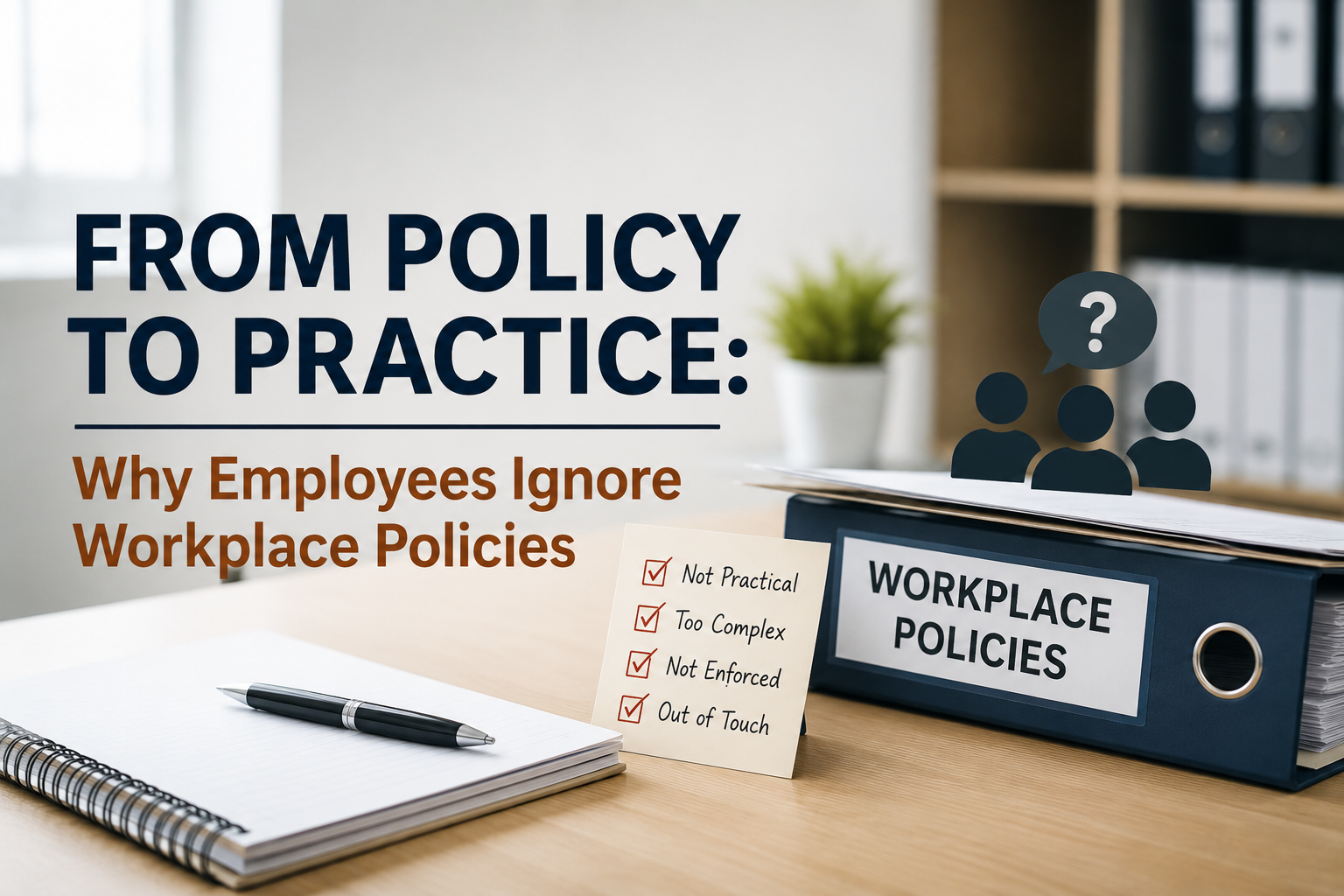
From Policy to Practice: Why Employees Ignore Workplace Policies

A well-written workplace policy is only as effective as its implementation.
An organization may have detailed policies covering attendance, leave, performance, conduct, disciplinary procedures, and employee benefits. Yet, despite having these policies in place, some organizations still struggle with repeated violations, employee complaints, and inconsistent workplace practices.
This raises an important question: If the policy is clear, why are employees not following it?
The answer is not always that employees are unwilling to comply. Sometimes, the problem lies in how the policy was introduced, communicated, managed, or enforced.

When Employees Don’t Understand the Policy

Employees cannot be expected to follow rules they do not understand.
Simply including a policy in an employee handbook or asking employees to sign a document does not guarantee that they have understood its meaning or how it applies to their daily work.
For example, an employee may know that the organization has an attendance policy but may not understand the procedure for reporting lateness, requesting time off, or notifying a manager about an unexpected absence.
Effective organizations go beyond issuing policies. They explain them, answer questions, and ensure employees understand what is expected.
Policy communication should not happen only when an employee violates a rule. It should be part of onboarding, training, team communication, and regular HR engagement.

When Managers Don’t Follow the Rules

One of the fastest ways to make employees lose respect for a workplace policy is to have managers ignore it.
Employees pay attention to what leaders do, not just what the employee handbook says. If managers consistently arrive late while employees are disciplined for lateness, or if certain employees are given exceptions that others are not, the credibility of the policy is weakened.
Leadership must therefore model the standards they expect employees to follow.
Managers also need to understand how policies should be applied. Even a fair policy can become unfair when managers interpret or enforce it differently across departments.

When Policies Become Too Difficult to Follow

Not every policy violation is a result of intentional misconduct.
Sometimes, employees struggle to follow policies because the policies themselves are unrealistic, complicated, or disconnected from how the organization actually operates.
Consider a policy that requires multiple levels of approval for a simple request or a procedure that employees find difficult to access. Over time, employees may begin to bypass the process—not necessarily because they reject the policy, but because the process creates unnecessary difficulty.
This is why organizations should periodically ask: Is this policy still practical?
A policy should provide structure without creating unnecessary bureaucracy.

Inconsistent Enforcement Creates Resistance

Employees are more likely to respect workplace policies when they know the rules apply fairly to everyone.
When the same violation receives different consequences depending on who committed it, employees may begin to question the purpose of the policy itself.
Inconsistent enforcement can create:

  • Perceptions of favouritism.
  • Reduced trust in management.
  • Employee resentment.
  • Increased workplace conflict.
  • A culture where employees selectively follow policies.

Consistency does not necessarily mean every situation receives exactly the same response. Circumstances may differ, and appropriate judgment is sometimes required. However, decisions should be based on clear and reasonable principles rather than personal relationships or individual preferences.

Policies Need to Be Reinforced, Not Just Enforced
A common mistake is to talk about a policy only when someone breaks it.
Employees are more likely to remember and respect policies when organizations reinforce them through regular communication, training, reminders, and leadership behaviour.
For example, if an organization introduces a new workplace conduct policy, employees should understand not only what the rules are but also why they exist, how they apply, and where they can seek clarification.
The objective should be to make compliance part of everyday workplace behaviour rather than something employees think about only when disciplinary action is involved.

Conclusion
A policy can be perfectly written and still fail if it is poorly communicated, impractical, inconsistently applied, or unsupported by leadership.
Creating policies employees respect therefore requires more than putting rules on paper. Organizations must ensure that employees understand the expectations, managers are equipped to implement them, and leadership consistently demonstrates the standards it expects from others.
Ultimately, employees are more likely to follow policies when they see that the organization takes those policies seriously too.
A policy becomes meaningful when it moves from the employee handbook into everyday workplace practice.

13Aug

Creating Fair Workplace Policies Employees Respect – What Makes a Workplace Policy Fair?

Creating workplace policies is only the first step. For a policy to be effective, employees must be able to understand it, see the reasoning behind it, and trust that it will be applied fairly.
A policy may look professional on paper, but if employees consider it unrealistic, unclear, biased, or selectively enforced, it is unlikely to earn their respect.
Fair workplace policies therefore require more than good wording. They require a thoughtful balance between the needs of the organization, the rights and responsibilities of employees, and the realities of the workplace.

Clear, Practical, and Easy to Understand

A fair policy should not leave employees guessing about what is expected of them.
Policies should clearly explain what employees are expected to do, the procedures they should follow, and what may happen when the policy is not followed. Avoiding unnecessary legal or technical language also makes policies easier for employees to understand and apply in their everyday work.
For example, an attendance policy should clearly state working hours, reporting procedures for lateness or absence, and the consequences of repeated violations.
Clarity reduces confusion and gives employees a fair opportunity to meet organizational expectations.

Fairness Means Consistency

One of the strongest tests of a workplace policy is how consistently it is applied.
Employees are more likely to respect a policy when they see that the same standards apply to everyone, regardless of position, department, or personal relationship with management.
If one employee is disciplined for breaking a rule while another is allowed to do the same thing without consequence, the problem becomes bigger than the original violation. It creates perceptions of favouritism and can damage trust in management.
A fair policy should therefore be supported by fair and consistent implementation.

Policies Should Reflect Both the Law and the Workplace

A workplace policy should not exist in isolation. It should align with applicable labour laws, regulatory requirements, and the organization’s values and operational realities.
However, legal compliance alone does not automatically make a policy effective.
A policy can be legally sound but still be impractical for the people expected to follow it. Employers should therefore consider whether the policy is realistic, relevant to the organization’s operations, and capable of being implemented consistently.
The goal is to create policies that protect the organization while also providing employees with reasonable and understandable expectations.

Employees Should Have a Voice Where Appropriate

Fairness does not necessarily mean that employees must approve every workplace policy. However, organizations can benefit from listening to employees when developing or reviewing policies that directly affect their day-to-day experience.
Seeking employee feedback can help management identify practical challenges, clarify areas of confusion, and anticipate how a policy may work in practice.
More importantly, employees are more likely to understand and accept policies when they feel that their experiences have been considered.
This does not mean every employee suggestion must be adopted. It means employees should have reasonable opportunities to provide input, particularly where appropriate.

Review Policies as the Workplace Changes

A policy that worked effectively several years ago may no longer reflect the realities of the organization today.
Businesses grow, work arrangements change, technology evolves, and employment laws can be updated. As these changes occur, workplace policies should also be reviewed to ensure that they remain relevant and effective.
Regular policy reviews can help organizations identify outdated provisions, remove unnecessary requirements, clarify confusing sections, and ensure continued compliance.
A policy should be a living framework that evolves with the organization—not a document that is written once and forgotten.

Conclusion

A fair workplace policy is one that employees can understand, realistically follow, and trust will be applied consistently.
Creating such policies requires more than copying templates or putting rules into an employee handbook. It requires employers to consider the organization’s needs while also thinking about how those policies affect the people expected to follow them.
When policies are clear, practical, lawful, consistently applied, and reviewed when necessary, employees are more likely to respect them.
Because employees do not respect policies simply because they exist. They respect policies when they see fairness behind the rules.

06Aug

Creating Fair Workplace Policies Employees Respect – Why Fair Workplace Policies Matter

Every organization, regardless of its size or industry, operates more effectively when there are clear expectations for how employees should work, interact, and conduct themselves. These expectations are often communicated through workplace policies, which serve as a guide for maintaining consistency, accountability, and professionalism across the organization.

Unfortunately, many businesses view workplace policies as mere administrative documents or legal requirements. In reality, well-developed policies are essential tools for creating a fair, productive, and well-managed workplace.

When workplace policies are clear, practical, and consistently applied, they not only support business operations but also build trust between employers and employees.

What Are Workplace Policies and Why Do They Matter?

Workplace policies are formal guidelines that outline an organization’s expectations, standards, and procedures. They help employees understand what is expected of them while providing employers with a consistent framework for managing workplace issues.

From attendance and leave management to performance, disciplinary procedures, and workplace conduct, policies provide direction for handling everyday situations fairly and consistently.

Without clearly defined policies, managers may make decisions based on personal judgment rather than established standards. This can create confusion, inconsistency, and unnecessary conflict within the workplace.

Simply put, workplace policies help ensure that everyone operates under the same set of expectations.

Fair Policies Create Consistency and Accountability

One of the greatest benefits of workplace policies is consistency. Employees are more likely to trust organizational decisions when they know that the same standards apply to everyone, regardless of job title or department.

Fair policies help organizations:

  • Establish clear expectations for employee behaviour and performance.
  • Promote accountability at every level of the organization.
  • Reduce misunderstandings and workplace disputes.
  • Support managers in making objective and consistent decisions.
  • Create a more structured and professional work environment.

When employees understand what is expected of them, they are better positioned to take responsibility for their actions and contribute positively to the organization.

Workplace Policies Protect Both Employers and Employees

Many people assume that workplace policies exist only to protect the employer. In reality, effective policies benefit both parties.

For employers, policies provide a framework for making fair and consistent decisions while reducing the risk of disputes, grievances, and legal challenges.

For employees, policies provide clarity, transparency, and confidence that workplace decisions will be guided by established procedures rather than personal opinions or favouritism.

When both employers and employees understand their rights, responsibilities, and expectations, the workplace becomes more stable and productive.

Common Mistakes Organizations Make When Developing Policies

Having workplace policies is important, but simply having them is not enough. Poorly designed policies can create as many problems as having no policies at all.

Some common mistakes include:

  • Using vague or confusing language.
  • Creating policies that are difficult to implement.
  • Failing to communicate policies effectively to employees.
  • Applying policies inconsistently across teams or departments.
  • Neglecting to review and update policies as the organization grows or workplace laws evolve.

Policies should be practical, relevant, and easy for employees to understand. Most importantly, they should reflect both legal requirements and the organization’s values.

Conclusion

Fair workplace policies are more than documents stored in an employee handbook. They are the foundation of a well-managed organization, providing clear expectations, supporting consistent decision-making, and promoting accountability across the workplace.

When employees understand workplace policies and see them applied fairly, they are more likely to trust leadership, respect organizational standards, and remain engaged in their work.

Organizations that invest time in developing fair, practical, and well-communicated policies are not only reducing workplace conflict—they are creating an environment where both employees and the business can thrive.

Because at the heart of every successful workplace is not just a set of rules, but a shared commitment to fairness, consistency, and mutual respect.