
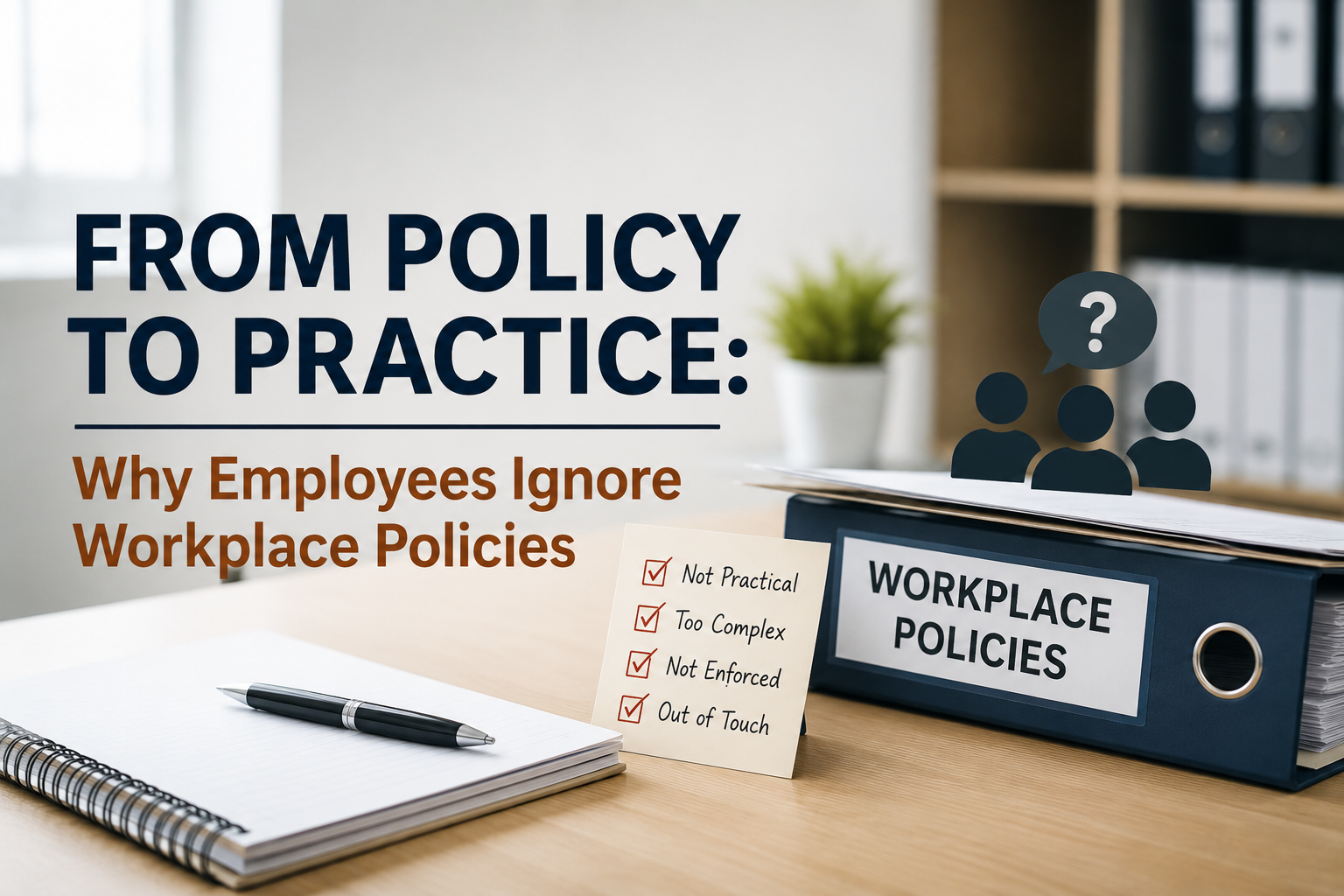
A well-written workplace policy is only as effective as its implementation.
An organization may have detailed policies covering attendance, leave, performance, conduct, disciplinary procedures, and employee benefits. Yet, despite having these policies in place, some organizations still struggle with repeated violations, employee complaints, and inconsistent workplace practices.
This raises an important question: If the policy is clear, why are employees not following it?
The answer is not always that employees are unwilling to comply. Sometimes, the problem lies in how the policy was introduced, communicated, managed, or enforced.
When Employees Don’t Understand the Policy
Employees cannot be expected to follow rules they do not understand.
Simply including a policy in an employee handbook or asking employees to sign a document does not guarantee that they have understood its meaning or how it applies to their daily work.
For example, an employee may know that the organization has an attendance policy but may not understand the procedure for reporting lateness, requesting time off, or notifying a manager about an unexpected absence.
Effective organizations go beyond issuing policies. They explain them, answer questions, and ensure employees understand what is expected.
Policy communication should not happen only when an employee violates a rule. It should be part of onboarding, training, team communication, and regular HR engagement.
When Managers Don’t Follow the Rules
One of the fastest ways to make employees lose respect for a workplace policy is to have managers ignore it.
Employees pay attention to what leaders do, not just what the employee handbook says. If managers consistently arrive late while employees are disciplined for lateness, or if certain employees are given exceptions that others are not, the credibility of the policy is weakened.
Leadership must therefore model the standards they expect employees to follow.
Managers also need to understand how policies should be applied. Even a fair policy can become unfair when managers interpret or enforce it differently across departments.
When Policies Become Too Difficult to Follow
Not every policy violation is a result of intentional misconduct.
Sometimes, employees struggle to follow policies because the policies themselves are unrealistic, complicated, or disconnected from how the organization actually operates.
Consider a policy that requires multiple levels of approval for a simple request or a procedure that employees find difficult to access. Over time, employees may begin to bypass the process—not necessarily because they reject the policy, but because the process creates unnecessary difficulty.
This is why organizations should periodically ask: Is this policy still practical?
A policy should provide structure without creating unnecessary bureaucracy.
Inconsistent Enforcement Creates Resistance
Employees are more likely to respect workplace policies when they know the rules apply fairly to everyone.
When the same violation receives different consequences depending on who committed it, employees may begin to question the purpose of the policy itself.
Inconsistent enforcement can create:
- Perceptions of favouritism.
- Reduced trust in management.
- Employee resentment.
- Increased workplace conflict.
- A culture where employees selectively follow policies.
Consistency does not necessarily mean every situation receives exactly the same response. Circumstances may differ, and appropriate judgment is sometimes required. However, decisions should be based on clear and reasonable principles rather than personal relationships or individual preferences.
Policies Need to Be Reinforced, Not Just Enforced
A common mistake is to talk about a policy only when someone breaks it.
Employees are more likely to remember and respect policies when organizations reinforce them through regular communication, training, reminders, and leadership behaviour.
For example, if an organization introduces a new workplace conduct policy, employees should understand not only what the rules are but also why they exist, how they apply, and where they can seek clarification.
The objective should be to make compliance part of everyday workplace behaviour rather than something employees think about only when disciplinary action is involved.
Conclusion
A policy can be perfectly written and still fail if it is poorly communicated, impractical, inconsistently applied, or unsupported by leadership.
Creating policies employees respect therefore requires more than putting rules on paper. Organizations must ensure that employees understand the expectations, managers are equipped to implement them, and leadership consistently demonstrates the standards it expects from others.
Ultimately, employees are more likely to follow policies when they see that the organization takes those policies seriously too.
A policy becomes meaningful when it moves from the employee handbook into everyday workplace practice.