
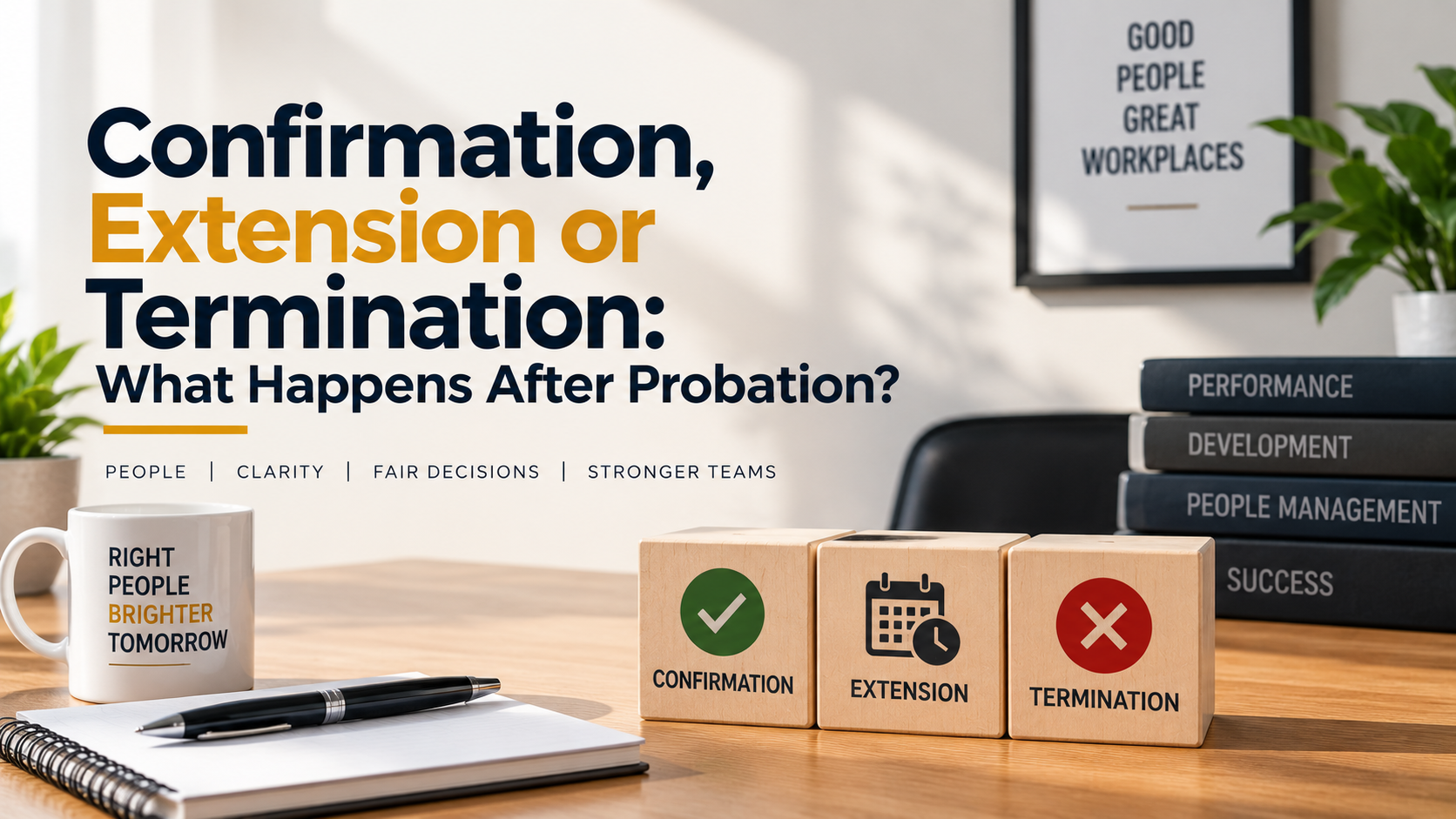
The probation period eventually comes to an end, and with it comes an important decision:
What happens next?
For the employer, it may be a decision between confirming the employee, extending the probation period or ending the employment relationship.
For the employee, it can be a period filled with anticipation — “Am I being confirmed?”
But this decision should not come as a surprise.
By the end of probation, both the employer and employee should have a clear understanding of how the employment relationship is progressing.
When Should an Employee Be Confirmed?
Confirmation should come when the employee has demonstrated that they can perform the responsibilities of the role and meet the organisation’s expectations.
Employers should consider factors such as:
- Performance and quality of work
- Attendance and punctuality
- Conduct and professionalism
- Ability to work with others
- Willingness to learn and improve
- Overall suitability for the role
Confirmation should be based on an assessment of the employee’s performance and the terms of their employment, rather than simply because the probation period has ended.
When Should Probation Be Extended?
Sometimes, an employee may show potential but still need more time to meet the required standard.
An extension may be considered where the organisation needs additional time to properly assess the employee or where specific areas of improvement have been identified.
However, an extension should not be vague.
The employee should understand:
- Why the probation is being extended
- How long the extension will last
- What areas need improvement
- What is expected during the extension
- When the next review will take place
An extension should provide a clear opportunity to improve, not simply postpone a difficult decision.
When Does Termination Become Necessary?
There may be situations where an employee does not meet the requirements of the role despite appropriate feedback, support and opportunities to improve.
Where the organisation decides that the employment relationship should end, the decision should be handled professionally and in line with the employment contract, applicable workplace policies and relevant employment requirements.
The fact that an employee is on probation does not mean that employers should handle the process carelessly.
Clear communication and proper documentation remain important.
Don’t Let Probation End Without a Decision
One common problem is when an employee completes their probation period but receives no confirmation, extension or clear communication.
They continue working, unsure of their status, while the organisation continues to postpone the decision.
This creates unnecessary uncertainty for the employee and can create administrative and employee-relations challenges for the organisation.
Employers should have a process for reviewing employees before their probation period ends and communicating the outcome appropriately.
Make the Decision Clear
Whether the outcome is confirmation, extension or termination, communication matters.
Employees should not have to guess what their status is or rely on assumptions from colleagues.
A clear decision helps the employee understand where they stand and allows the organisation to move forward with certainty.
Probation should therefore end with a clear outcome — not continued uncertainty.
Conclusion
The end of probation is not simply about ticking a box.
It is the point at which the organisation uses the information gathered during the probation period to make a considered decision about the employment relationship.
Confirm when the employee has demonstrated suitability. Extend when there is a genuine and clearly communicated reason to assess further. And where the required standard cannot be met, take the appropriate steps to end the relationship professionally.
The important thing is not to avoid difficult decisions.
It is to make them fairly, clearly and responsibly.