19Aug

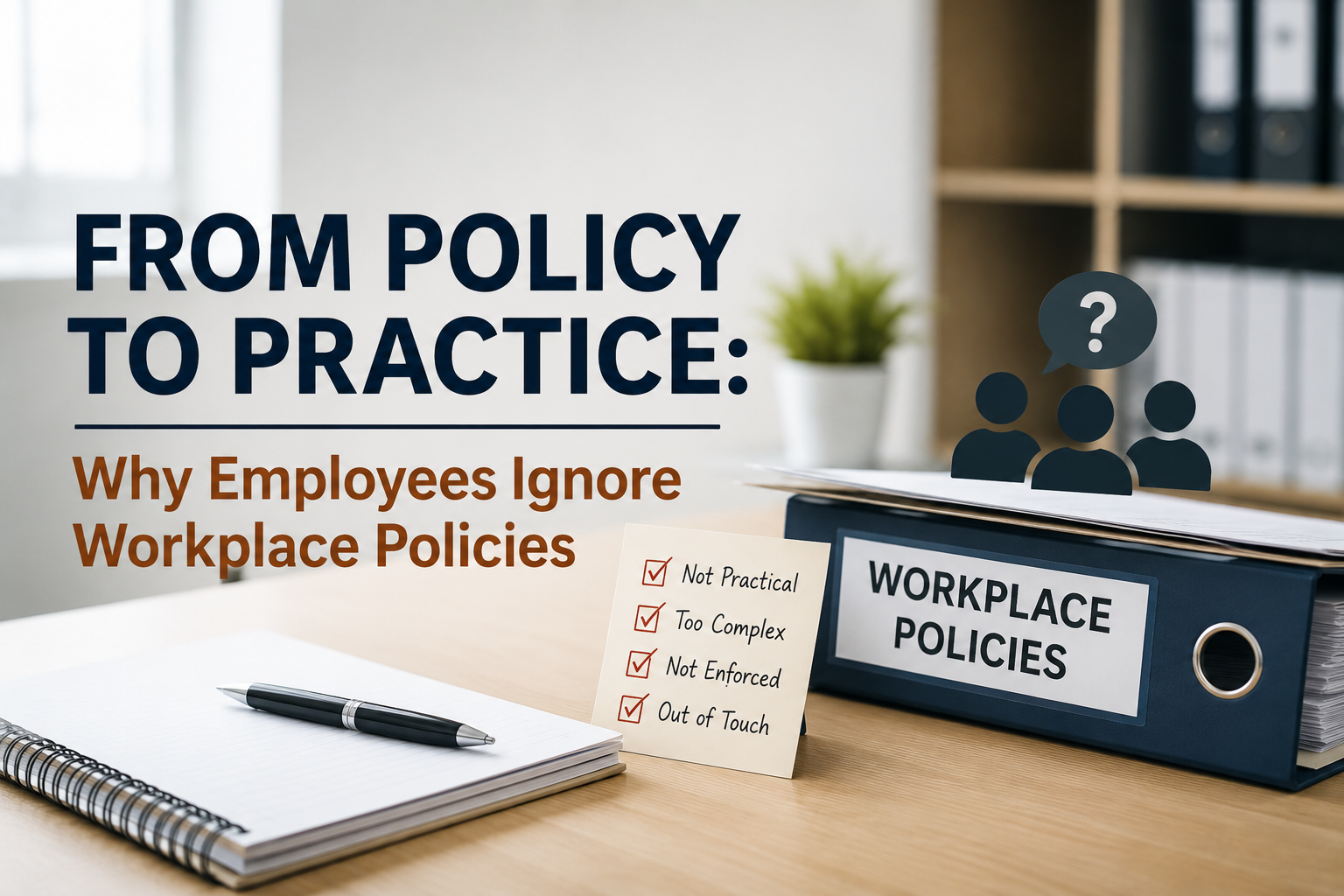
From Policy to Practice: Why Employees Ignore Workplace Policies

A well-written workplace policy is only as effective as its implementation.
An organization may have detailed policies covering attendance, leave, performance, conduct, disciplinary procedures, and employee benefits. Yet, despite having these policies in place, some organizations still struggle with repeated violations, employee complaints, and inconsistent workplace practices.
This raises an important question: If the policy is clear, why are employees not following it?
The answer is not always that employees are unwilling to comply. Sometimes, the problem lies in how the policy was introduced, communicated, managed, or enforced.

When Employees Don’t Understand the Policy

Employees cannot be expected to follow rules they do not understand.
Simply including a policy in an employee handbook or asking employees to sign a document does not guarantee that they have understood its meaning or how it applies to their daily work.
For example, an employee may know that the organization has an attendance policy but may not understand the procedure for reporting lateness, requesting time off, or notifying a manager about an unexpected absence.
Effective organizations go beyond issuing policies. They explain them, answer questions, and ensure employees understand what is expected.
Policy communication should not happen only when an employee violates a rule. It should be part of onboarding, training, team communication, and regular HR engagement.

When Managers Don’t Follow the Rules

One of the fastest ways to make employees lose respect for a workplace policy is to have managers ignore it.
Employees pay attention to what leaders do, not just what the employee handbook says. If managers consistently arrive late while employees are disciplined for lateness, or if certain employees are given exceptions that others are not, the credibility of the policy is weakened.
Leadership must therefore model the standards they expect employees to follow.
Managers also need to understand how policies should be applied. Even a fair policy can become unfair when managers interpret or enforce it differently across departments.

When Policies Become Too Difficult to Follow

Not every policy violation is a result of intentional misconduct.
Sometimes, employees struggle to follow policies because the policies themselves are unrealistic, complicated, or disconnected from how the organization actually operates.
Consider a policy that requires multiple levels of approval for a simple request or a procedure that employees find difficult to access. Over time, employees may begin to bypass the process—not necessarily because they reject the policy, but because the process creates unnecessary difficulty.
This is why organizations should periodically ask: Is this policy still practical?
A policy should provide structure without creating unnecessary bureaucracy.

Inconsistent Enforcement Creates Resistance

Employees are more likely to respect workplace policies when they know the rules apply fairly to everyone.
When the same violation receives different consequences depending on who committed it, employees may begin to question the purpose of the policy itself.
Inconsistent enforcement can create:

  • Perceptions of favouritism.
  • Reduced trust in management.
  • Employee resentment.
  • Increased workplace conflict.
  • A culture where employees selectively follow policies.

Consistency does not necessarily mean every situation receives exactly the same response. Circumstances may differ, and appropriate judgment is sometimes required. However, decisions should be based on clear and reasonable principles rather than personal relationships or individual preferences.

Policies Need to Be Reinforced, Not Just Enforced
A common mistake is to talk about a policy only when someone breaks it.
Employees are more likely to remember and respect policies when organizations reinforce them through regular communication, training, reminders, and leadership behaviour.
For example, if an organization introduces a new workplace conduct policy, employees should understand not only what the rules are but also why they exist, how they apply, and where they can seek clarification.
The objective should be to make compliance part of everyday workplace behaviour rather than something employees think about only when disciplinary action is involved.

Conclusion
A policy can be perfectly written and still fail if it is poorly communicated, impractical, inconsistently applied, or unsupported by leadership.
Creating policies employees respect therefore requires more than putting rules on paper. Organizations must ensure that employees understand the expectations, managers are equipped to implement them, and leadership consistently demonstrates the standards it expects from others.
Ultimately, employees are more likely to follow policies when they see that the organization takes those policies seriously too.
A policy becomes meaningful when it moves from the employee handbook into everyday workplace practice.

13Aug

Creating Fair Workplace Policies Employees Respect – What Makes a Workplace Policy Fair?

Creating workplace policies is only the first step. For a policy to be effective, employees must be able to understand it, see the reasoning behind it, and trust that it will be applied fairly.
A policy may look professional on paper, but if employees consider it unrealistic, unclear, biased, or selectively enforced, it is unlikely to earn their respect.
Fair workplace policies therefore require more than good wording. They require a thoughtful balance between the needs of the organization, the rights and responsibilities of employees, and the realities of the workplace.

Clear, Practical, and Easy to Understand

A fair policy should not leave employees guessing about what is expected of them.
Policies should clearly explain what employees are expected to do, the procedures they should follow, and what may happen when the policy is not followed. Avoiding unnecessary legal or technical language also makes policies easier for employees to understand and apply in their everyday work.
For example, an attendance policy should clearly state working hours, reporting procedures for lateness or absence, and the consequences of repeated violations.
Clarity reduces confusion and gives employees a fair opportunity to meet organizational expectations.

Fairness Means Consistency

One of the strongest tests of a workplace policy is how consistently it is applied.
Employees are more likely to respect a policy when they see that the same standards apply to everyone, regardless of position, department, or personal relationship with management.
If one employee is disciplined for breaking a rule while another is allowed to do the same thing without consequence, the problem becomes bigger than the original violation. It creates perceptions of favouritism and can damage trust in management.
A fair policy should therefore be supported by fair and consistent implementation.

Policies Should Reflect Both the Law and the Workplace

A workplace policy should not exist in isolation. It should align with applicable labour laws, regulatory requirements, and the organization’s values and operational realities.
However, legal compliance alone does not automatically make a policy effective.
A policy can be legally sound but still be impractical for the people expected to follow it. Employers should therefore consider whether the policy is realistic, relevant to the organization’s operations, and capable of being implemented consistently.
The goal is to create policies that protect the organization while also providing employees with reasonable and understandable expectations.

Employees Should Have a Voice Where Appropriate

Fairness does not necessarily mean that employees must approve every workplace policy. However, organizations can benefit from listening to employees when developing or reviewing policies that directly affect their day-to-day experience.
Seeking employee feedback can help management identify practical challenges, clarify areas of confusion, and anticipate how a policy may work in practice.
More importantly, employees are more likely to understand and accept policies when they feel that their experiences have been considered.
This does not mean every employee suggestion must be adopted. It means employees should have reasonable opportunities to provide input, particularly where appropriate.

Review Policies as the Workplace Changes

A policy that worked effectively several years ago may no longer reflect the realities of the organization today.
Businesses grow, work arrangements change, technology evolves, and employment laws can be updated. As these changes occur, workplace policies should also be reviewed to ensure that they remain relevant and effective.
Regular policy reviews can help organizations identify outdated provisions, remove unnecessary requirements, clarify confusing sections, and ensure continued compliance.
A policy should be a living framework that evolves with the organization—not a document that is written once and forgotten.

Conclusion

A fair workplace policy is one that employees can understand, realistically follow, and trust will be applied consistently.
Creating such policies requires more than copying templates or putting rules into an employee handbook. It requires employers to consider the organization’s needs while also thinking about how those policies affect the people expected to follow them.
When policies are clear, practical, lawful, consistently applied, and reviewed when necessary, employees are more likely to respect them.
Because employees do not respect policies simply because they exist. They respect policies when they see fairness behind the rules.

06Aug

Creating Fair Workplace Policies Employees Respect – Why Fair Workplace Policies Matter

Every organization, regardless of its size or industry, operates more effectively when there are clear expectations for how employees should work, interact, and conduct themselves. These expectations are often communicated through workplace policies, which serve as a guide for maintaining consistency, accountability, and professionalism across the organization.

Unfortunately, many businesses view workplace policies as mere administrative documents or legal requirements. In reality, well-developed policies are essential tools for creating a fair, productive, and well-managed workplace.

When workplace policies are clear, practical, and consistently applied, they not only support business operations but also build trust between employers and employees.

What Are Workplace Policies and Why Do They Matter?

Workplace policies are formal guidelines that outline an organization’s expectations, standards, and procedures. They help employees understand what is expected of them while providing employers with a consistent framework for managing workplace issues.

From attendance and leave management to performance, disciplinary procedures, and workplace conduct, policies provide direction for handling everyday situations fairly and consistently.

Without clearly defined policies, managers may make decisions based on personal judgment rather than established standards. This can create confusion, inconsistency, and unnecessary conflict within the workplace.

Simply put, workplace policies help ensure that everyone operates under the same set of expectations.

Fair Policies Create Consistency and Accountability

One of the greatest benefits of workplace policies is consistency. Employees are more likely to trust organizational decisions when they know that the same standards apply to everyone, regardless of job title or department.

Fair policies help organizations:

  • Establish clear expectations for employee behaviour and performance.
  • Promote accountability at every level of the organization.
  • Reduce misunderstandings and workplace disputes.
  • Support managers in making objective and consistent decisions.
  • Create a more structured and professional work environment.

When employees understand what is expected of them, they are better positioned to take responsibility for their actions and contribute positively to the organization.

Workplace Policies Protect Both Employers and Employees

Many people assume that workplace policies exist only to protect the employer. In reality, effective policies benefit both parties.

For employers, policies provide a framework for making fair and consistent decisions while reducing the risk of disputes, grievances, and legal challenges.

For employees, policies provide clarity, transparency, and confidence that workplace decisions will be guided by established procedures rather than personal opinions or favouritism.

When both employers and employees understand their rights, responsibilities, and expectations, the workplace becomes more stable and productive.

Common Mistakes Organizations Make When Developing Policies

Having workplace policies is important, but simply having them is not enough. Poorly designed policies can create as many problems as having no policies at all.

Some common mistakes include:

  • Using vague or confusing language.
  • Creating policies that are difficult to implement.
  • Failing to communicate policies effectively to employees.
  • Applying policies inconsistently across teams or departments.
  • Neglecting to review and update policies as the organization grows or workplace laws evolve.

Policies should be practical, relevant, and easy for employees to understand. Most importantly, they should reflect both legal requirements and the organization’s values.

Conclusion

Fair workplace policies are more than documents stored in an employee handbook. They are the foundation of a well-managed organization, providing clear expectations, supporting consistent decision-making, and promoting accountability across the workplace.

When employees understand workplace policies and see them applied fairly, they are more likely to trust leadership, respect organizational standards, and remain engaged in their work.

Organizations that invest time in developing fair, practical, and well-communicated policies are not only reducing workplace conflict—they are creating an environment where both employees and the business can thrive.

Because at the heart of every successful workplace is not just a set of rules, but a shared commitment to fairness, consistency, and mutual respect.

30Jul

Creating an Attendance Improvement Plan: Practical Strategies for Employers

Over the past three weeks, we have explored why workplace attendance matters, the common causes of lateness, and when attendance concerns become disciplinary issues. While policies and disciplinary procedures are important, the most effective organizations understand that improving attendance requires more than simply responding to problems as they arise.
A structured attendance improvement plan helps employers identify attendance concerns early, address them fairly, and encourage lasting behavioural change. Rather than relying solely on disciplinary action, organizations can adopt proactive strategies that improve attendance while maintaining positive employee relationships.

Monitor Attendance Consistently

The first step in improving attendance is understanding it. Employers should maintain accurate attendance records and review them regularly to identify patterns and trends.
Questions employers should ask include:

  • Is the employee frequently late on certain days?
  • Are absences becoming more frequent?
  • Is the issue isolated to one employee or affecting multiple employees?
  • Are there workplace factors contributing to poor attendance?

Reliable attendance records enable employers to make informed decisions based on facts rather than assumptions.

Address Attendance Concerns Early

One of the biggest mistakes organizations make is waiting until attendance problems become severe before taking action.
A simple conversation at the first sign of a pattern can often prevent the issue from escalating. Early intervention demonstrates that attendance is taken seriously while also giving employees an opportunity to explain any challenges they may be experiencing.
Addressing concerns promptly is often more effective than waiting until disciplinary action becomes necessary.

Work with Employees to Develop an Improvement Plan

Once the cause of poor attendance has been identified, employers should work collaboratively with the employee to develop realistic improvement goals.
An attendance improvement plan may include:

  • Clearly defined attendance expectations.
  • Agreed timelines for improvement.
  • Regular follow-up meetings.
  • Coaching or additional support where appropriate.
  • A commitment from both the employer and employee to monitor progress.

Employees are more likely to improve when expectations are clear and they feel supported throughout the process.

Recognize Improvement and Maintain Accountability

Improvement should not go unnoticed. When employees demonstrate positive changes in their attendance, acknowledging their effort can reinforce the behaviour and encourage continued consistency.
At the same time, employers should continue to monitor attendance and apply workplace policies fairly if improvement is not sustained. Recognition and accountability should work together, creating an environment where employees are encouraged to succeed while understanding the importance of meeting organizational standards.

Review Policies and Workplace Practices

Sometimes attendance challenges point to broader organizational issues rather than individual employee behaviour.
Employers should periodically review their attendance policies, workplace practices, and management approach to ensure they remain effective, practical, and clearly communicated. They should also assess whether factors such as excessive workloads, burnout, poor communication, or unrealistic scheduling are contributing to attendance concerns.
By addressing both individual and organizational factors, businesses are more likely to achieve long-term improvements in attendance.

Conclusion
Improving attendance is not about enforcing rules alone. It requires consistency, communication, early intervention, and a genuine commitment to helping employees succeed.
Organizations that monitor attendance proactively, address concerns promptly, support employees through improvement plans, and apply policies fairly are more likely to build dependable teams and strengthen overall business performance.
An effective attendance improvement plan is more than an HR process—it is a practical strategy for building a workplace where reliability, accountability, and professionalism become part of the organizational culture.

23Jul

Attendance and Workplace Discipline: When Does Corrective Action Become Necessary?

Every organization expects employees to meet certain standards of conduct, performance, and professionalism. When these standards are not met, workplace discipline becomes necessary. However, one of the biggest misconceptions about discipline is that it exists to punish employees.
In reality, effective workplace discipline is designed to correct behaviour, reinforce accountability, and help employees improve. When applied fairly and consistently, discipline protects both the organization and its employees while promoting a culture of professionalism and respect.
The goal should never be to find reasons to punish employees. Instead, it should be to address concerns early, encourage positive behavioural change, and maintain workplace standards.

Attendance Policies Are Only Effective When They Are Enforced

Many organizations have attendance policies in place, but policies alone do not improve employee behaviour. Their effectiveness depends on consistent implementation.
Employees should clearly understand:

  • Expected working hours.
  • Procedures for reporting lateness or absence.
  • Attendance expectations.
  • The consequences of repeated attendance violations.

When attendance policies are communicated clearly and applied consistently, employees are more likely to understand their responsibilities and take ownership of their attendance.

When Does Poor Attendance Become a Discipline Issue?

Not every instance of lateness or absenteeism should result in disciplinary action. Genuine illness, emergencies, or unforeseen circumstances can occasionally affect an employee’s attendance.
However, attendance becomes a disciplinary concern when there is a repeated pattern of behaviour without reasonable justification.
Examples include:

  • Frequent lateness despite previous discussions.
  • Repeated unauthorized absences.
  • Failure to follow the organization’s absence reporting procedures.
  • Ignoring attendance expectations after coaching or warnings.
  • Demonstrating a pattern of poor attendance that affects work performance and team operations.

At this stage, the issue is no longer simply about arriving late or missing work—it is about failing to meet established workplace expectations.

Correcting Behaviour Through Progressive Discipline

One of the biggest mistakes employers make is treating discipline as punishment. Effective discipline is intended to help employees recognise the impact of their behaviour and provide them with a fair opportunity to improve.
For attendance-related issues, organizations should adopt a progressive approach wherever appropriate.
A typical process may include:

  • Coaching or an informal discussion.
  • A verbal warning.
  • A written warning.
  • A final written warning.
  • Further disciplinary action where improvement is not achieved or where company policy requires it.

Each stage gives employees an opportunity to understand expectations, correct their behaviour, and demonstrate improvement.
Progressive discipline also helps ensure that decisions are fair, transparent, and supported by evidence.

Why Fairness and Consistency Matter

Attendance policies should apply equally to every employee, regardless of position or department.
Before taking disciplinary action, employers should take time to understand the circumstances surrounding the attendance issue. Investigating the facts allows managers to distinguish between genuine challenges and repeated disregard for workplace expectations.
Consistency is equally important. Applying attendance rules differently to different employees can create perceptions of favouritism, reduce trust in management, and weaken workplace discipline.
Employers should also document attendance concerns, discussions, warnings, and improvement plans. Proper documentation promotes transparency, supports fair decision-making, and provides an accurate record if future action becomes necessary.

Conclusion
Attendance management is not simply about recording who is present and who is absent. It is about creating a workplace where employees understand that reliability, punctuality, and accountability are essential to organizational success.
When attendance issues arise, employers should respond with fairness, consistency, and professionalism. By combining clear expectations, proper investigation, progressive discipline, and effective documentation, organizations can correct behaviour while maintaining positive employee relations.
Ultimately, the goal of attendance discipline is not to punish employees—it is to help them improve, protect workplace standards, and build a culture where accountability becomes everyone’s responsibility.

15Jul

Lateness in the Workplace: Understanding the Cause Before Managing the Behaviour

Punctuality is one of the simplest yet most important expectations in any workplace. Arriving at work on time demonstrates professionalism, reliability, and respect for colleagues and organizational commitments. However, despite clear expectations, lateness remains one of the most common workplace challenges faced by employers.

An occasional late arrival is unlikely to raise concern. Unexpected circumstances can affect even the most reliable employees. However, when lateness becomes frequent or habitual, it begins to affect productivity, team morale, and overall business performance.

Before employers conclude that an employee is simply careless or uncommitted, it is important to ask a critical question: What is causing the lateness?

Understanding the reason behind the behaviour allows organizations to respond fairly, address underlying issues where appropriate, and maintain workplace standards without making assumptions.

Understanding the Common Causes of Lateness

Not every instance of lateness has the same explanation. While some employees may struggle with personal discipline, others may be dealing with genuine challenges that affect their ability to arrive at work on time.

Some of the most common causes include:

Traffic and transportation challenges : In many cities, unpredictable traffic congestion, public transportation delays, or long commuting distances can occasionally result in employees arriving late. While these factors should not become routine excuses, employers should recognise that they are sometimes beyond an employee’s control.

Poor planning and time management: Some employees consistently underestimate travel time, oversleep, or fail to plan their mornings effectively. In these situations, the issue is often behavioural and can be improved through coaching, accountability, and better personal organisation.

Burnout and workplace stress: Employees experiencing excessive workloads, long working hours, or prolonged stress may begin to show signs of fatigue and disengagement. Persistent lateness can sometimes be an early indicator that an employee is struggling rather than simply being irresponsible.

Low motivation or disengagement: When employees no longer feel connected to their work, recognised for their contributions, or optimistic about their future within the organisation, punctuality may begin to decline. While disengagement does not excuse lateness, it may signal deeper workplace issues that require attention.

Personal or family challenges: Family responsibilities, childcare arrangements, health concerns, or other personal circumstances can occasionally affect an employee’s attendance. Employers should be willing to listen while ensuring that workplace expectations remain clear.

Identifying the cause of lateness helps employers determine whether the issue requires support, coaching, or disciplinary action.

When Lateness Becomes Misconduct

Not every late arrival should be treated as misconduct. Employees may occasionally experience circumstances beyond their control, and isolated incidents can often be resolved through communication.

However, repeated lateness without reasonable justification is a different matter. When an employee consistently fails to report to work on time despite reminders, coaching, or previous warnings, the behaviour shifts from being an attendance issue to a disciplinary concern.

At this stage, lateness reflects a failure to meet workplace expectations and demonstrates a lack of accountability. It may also amount to misconduct where an employee deliberately ignores established attendance policies or repeatedly disregards management instructions.

Employers should ensure that attendance expectations are clearly communicated and consistently enforced so employees understand when repeated lateness may lead to formal disciplinary action.

The Impact of Repeated Lateness on Colleagues and Business Performance

Repeated lateness affects far more than the employee involved. It can disrupt workflows, reduce efficiency, and place unnecessary pressure on the rest of the team.

When employees arrive late regularly, colleagues are often required to cover responsibilities until they arrive. This increases workloads, interrupts planned schedules, and may create frustration among employees who consistently meet attendance expectations.

From a business perspective, repeated lateness can delay meetings, slow project completion, reduce customer service standards, and affect operational efficiency. Over time, it can also weaken workplace discipline if employees begin to believe that attendance policies are not being enforced consistently.

Perhaps most importantly, repeated lateness can influence workplace culture. Employees are more likely to remain punctual when they see attendance standards being applied fairly to everyone. Conversely, inconsistent enforcement may lead to perceptions of favouritism and reduce accountability across the organisation.

Why Employers Should Investigate Before Applying Discipline

One of the most common mistakes employers make is assuming that every case of lateness deserves immediate punishment.

Effective employee relations require employers to understand the circumstances before deciding on the appropriate response. A simple conversation may reveal challenges that can be addressed through reasonable support, clearer expectations, or practical workplace solutions.

Where the issue relates to poor planning or a disregard for company policy, disciplinary action may be appropriate. However, where genuine personal or workplace factors are contributing to the behaviour, coaching or temporary support may produce a better long-term outcome.

Investigating before disciplining demonstrates fairness, promotes consistency, and helps employers make objective decisions based on facts rather than assumptions. It also strengthens trust between employees and management while maintaining accountability.

Conclusion

Lateness should never be dismissed as “just a few minutes.” Left unaddressed, it can affect productivity, reduce team morale, weaken workplace discipline, and influence the overall culture of an organisation.

At the same time, effective employers recognise that managing lateness requires more than simply issuing warnings. It requires understanding the cause, applying policies consistently, and balancing empathy with accountability.

By addressing lateness fairly and proactively, organisations can strengthen attendance, improve employee performance, and build a workplace culture where punctuality is seen not just as a rule, but as a shared responsibility.

08Jul

Attendance in the Workplace: Why It Matters More Than You Think

When people think about workplace performance, they often focus on productivity, technical skills, or meeting targets. However, one of the most overlooked indicators of a high-performing workforce is attendance.

Attendance is more than just being physically present at work. It reflects an employee’s reliability, commitment, and accountability. When employees consistently show up on time and are present when expected, they contribute to a more productive, efficient, and dependable workplace.

For employers, attendance is not just an HR metric; it is a key driver of business performance. Every organization, regardless of its size or industry, depends on employees being available to perform their responsibilities consistently. When attendance becomes unreliable, it can affect not only individual performance but also the success of the entire business.

Attendance Is More Than Just Showing Up

Every organization depends on people fulfilling their roles consistently. When employees are absent without notice or frequently miss work, daily operations can be disrupted. Colleagues may have to take on additional responsibilities, deadlines can be missed, customer service may suffer, and overall productivity can decline.

Consistent attendance creates stability within the workplace. Teams can plan effectively, workloads are distributed fairly, and employees can rely on one another to achieve shared goals. It also demonstrates professionalism and respect for colleagues whose work may depend on everyone being present.

Simply put, businesses perform better when employees can depend on one another.

The Hidden Cost of Poor Attendance

Many employers focus on the immediate inconvenience of absenteeism but overlook its wider impact on the business. One employee’s repeated absence can create a ripple effect that extends far beyond the individual.
Poor attendance can lead to:

  1. Reduced team productivity: When employees are absent unexpectedly, work is often redistributed among other team members. This can increase workloads, disrupt priorities, and make it difficult for teams to meet deadlines or maintain the same level of efficiency.
  2. Increased pressure on colleagues: Frequent absenteeism places additional responsibility on other employees who must cover unfinished tasks or work longer hours. Over time, this can lead to frustration, fatigue, and lower morale, especially if the pattern continues without being addressed.
  3. Delays in service delivery: Whether an organization provides products or services, consistent attendance is essential to keeping operations running smoothly. Repeated absences can delay projects, slow decision-making, and affect the organization’s ability to meet customer expectations.
  4. Higher operational costs: Poor attendance often results in overtime payments, temporary staffing, rescheduling of work, or reduced productivity. While these costs may appear manageable at first, they can accumulate over time and have a significant impact on business performance.
  5. A negative impact on workplace culture: Attendance habits can influence the behaviour of an entire team. When repeated absenteeism is ignored or handled inconsistently, other employees may begin to see attendance expectations as optional, weakening accountability and creating perceptions of unfairness.

For these reasons, attendance should never be viewed as just another HR statistic. It is a business issue that affects productivity, teamwork, employee morale, customer satisfaction, and ultimately, organizational success.

Building a Culture of Accountability

While employees have a responsibility to meet attendance expectations, employers also play an important role in creating a workplace that encourages reliability and accountability.

Organizations should communicate attendance expectations clearly from the outset. Employees need to understand working hours, reporting procedures for absences, and the consequences of repeated lateness or absenteeism. At the same time, employers should recognise that genuine situations such as illness, family emergencies, or unforeseen circumstances may occasionally affect attendance. Applying attendance policies fairly and consistently helps build trust while maintaining accountability.

Strong attendance is rarely achieved through strict policies alone. It is built through effective leadership, clear communication, consistency, and a workplace culture that values responsibility. Managers who lead by example and recognize dependable employees are more likely to encourage the same behaviour across their teams.

Conclusion

Attendance may seem like a basic workplace expectation, but its impact reaches every part of an organization. It influences productivity, teamwork, customer experience, and ultimately, business success.

Organizations that treat attendance as a core part of their workplace culture rather than just an administrative requirement are better positioned to build reliable teams and achieve sustainable growth.

Because in every successful organization, excellence doesn’t just come from how people perform when they are at work—it begins with showing up consistently.

17Jun

Why Workplace Culture Matters More to Gen Z Employees Today

While salary may attract Gen Z employees, workplace culture often determines whether they stay.
Today’s younger workforce is paying closer attention to how they are treated, the environment they work in, opportunities for growth, leadership style, flexibility, communication, and overall job satisfaction. Many Gen Z employees are willing to leave high-paying jobs if the workplace becomes unhealthy, stressful, overly rigid, or unsupportive.
For this generation, work is no longer just about earning a salary. Employees also want to enjoy where they work and feel connected to the organization they are part of.

What Gen Z Employees Value in Workplace Culture
Gen Z employees want to work in environments where they feel respected, heard, supported, appreciated, and included. They value organizations that genuinely care about employee wellbeing and create positive work experiences.

A positive workplace culture for Gen Z employees often includes:

  • Respectful leadership
  • Open and honest communication
  • Employee recognition and appreciation
  • Career growth opportunities
  • Team collaboration
  • Fair treatment
  • Work-life balance
  • Flexibility where possible
    Many young professionals also prefer workplaces where they can express ideas freely, receive feedback regularly, and feel that their contributions actually matter within the organization.
    Employees want to feel appreciated, not just paid.

The Mistake Many Employers Make
Some organizations believe salary alone is enough to retain Gen Z employees. As a result, they ignore workplace issues such as toxic management, burnout, poor communication, lack of recognition, or poor employee engagement.
Others focus heavily on creating a “friendly culture” while neglecting fair compensation and financial growth opportunities.
Both approaches can lead to employee dissatisfaction because Gen Z employees are often looking for balance. They want both a healthy workplace culture and compensation that reflects their value.

How Employers Can Create the Right Balance
Organizations that successfully retain Gen Z employees usually combine competitive compensation with a healthy workplace culture.

Practical ways employers can improve retention include:

  • Improving communication within teams
  • Recognizing employee efforts consistently
  • Investing in employee development and training
  • Promoting work-life balance
  • Reviewing salary structures regularly
  • Creating a respectful and inclusive environment
  • Encouraging supportive leadership practices

For Gen Z employees, workplace culture is no longer just an added benefit — it is now a major factor in deciding where to work and whether to stay long term.
However, workplace culture alone is not enough. Organizations that balance employee wellbeing with fair compensation are more likely to build stable, productive, and loyal teams in today’s evolving workforce. Retention improves when employees experience both financial and emotional satisfaction at work.

10Jun

Why Salary Still Matters in Retaining Gen Z Employees

One of the biggest questions many employers ask today is: What really makes Gen Z employees stay — salary or workplace culture?
While workplace culture has become increasingly important in today’s work environment, salary still plays a major role in attracting and retaining young talent. Gen Z employees want to feel that their skills, effort, time, and contributions are fairly compensated.

Competitive pay helps employees:

  • Meet personal and financial responsibilities
  • Feel valued by the organization
  • Stay motivated and committed
  • Reduce financial stress
  • Build confidence in their future within the company

When Gen Z employees consistently feel underpaid compared to their workload or industry standards, dissatisfaction can grow quickly. Many younger employees are now more aware of salary trends, career opportunities, and workplace standards than previous generations. As a result, organizations that fail to review compensation structures may struggle with employee retention.

Signs Salary May Be Affecting Retention
Many organizations lose talented Gen Z employees not necessarily because the workplace is toxic, but because compensation no longer matches employee expectations or market realities.

Common signs include:

  • Employees frequently complaining about compensation
  • High turnover after salary reviews
  • Difficulty attracting quality young talent
  • Employees leaving for slightly higher-paying opportunities elsewhere
  • Reduced motivation and engagement at work

Fair compensation remains a critical part of employee satisfaction. While salary may not be the only reason employees stay, unfair compensation can easily become the reason they leave.

The New Workforce Perspective
Today’s workforce, especially Gen Z employees, tends to prioritize workplace experience more than previous generations. However, this does not mean salary is no longer important.
Gen Z employees still want:

  • Financial growth
  • Stability and security
  • Recognition for their effort
  • Competitive compensation
  • Opportunities for career advancement

The difference is that many young professionals are now evaluating the complete work experience rather than salary alone. Employees want to earn well while also working in environments where they feel respected, supported, and appreciated.

How Employers Can Create the Right Balance
Organizations that successfully retain Gen Z employees understand that compensation and workplace culture must work together.
Practical ways employers can create balance include:

  • Conducting regular salary reviews
  • Recognizing and rewarding employee efforts
  • Creating opportunities for growth and development
  • Promoting work-life balance
  • Encouraging healthy communication within teams
  • Building a respectful and inclusive work environment

Salary remains an important part of the employee experience, especially for Gen Z professionals who value financial growth and stability. However, organizations must understand that salary alone is no longer enough to guarantee loyalty. Employees are more likely to stay committed when they feel both financially valued and professionally respected.
Businesses that combine fair compensation with a healthy workplace culture are more likely to attract, engage, and retain the next generation of talent.

03Jun

Common Mistakes Companies Make When Managing Gen Z Employees

Many organizations today are hiring more Gen Z employees, yet many employers still struggle to understand how to effectively manage this new generation of talent. As a result, businesses often experience high turnover, low engagement, communication gaps, and declining productivity among younger employees.

Gen Z employees are not necessarily difficult to manage. In many cases, companies simply apply outdated workplace approaches to a generation that values flexibility, growth, communication, and purpose differently.

Here are some of the most common mistakes companies make when managing Gen Z employees and how businesses can avoid them.
1 . Poor Communication Culture
One of the biggest frustrations for Gen Z employees is unclear or inconsistent communication. Many young employees prefer direct, transparent, and timely communication rather than rigid corporate structures where feedback is limited.
Some managers assume employees should simply “figure things out” over time, but Gen Z employees often perform better when expectations are clearly communicated.

What employers should do instead:

  • Communicate expectations clearly
  • Encourage open conversations
  • Provide regular updates and feedback
  • Create an environment where employees feel heard
  • Good communication improves trust, confidence, and productivity.

2. Micromanaging Employees
Many companies struggle with giving younger employees autonomy. Constant monitoring, excessive control, and lack of trust can quickly frustrate Gen Z employees and reduce motivation.
This generation values independence and wants to feel trusted to complete tasks effectively.

What employers should do instead:

  • Focus on results rather than excessive supervision
  • Allow employees take ownership of tasks
  • Encourage initiative and creativity
  • Build trust gradually through accountability
  • Employees who feel trusted are often more engaged and productive.

3. Ignoring Employee Growth and Development
Gen Z employees are highly growth-oriented. Many young professionals want opportunities to learn, improve skills, and advance in their careers.
When employees feel stuck in repetitive roles with no development opportunities, they are more likely to lose interest or leave the organization.

What employers should do instead:

  • Provide learning opportunities
  • Encourage mentorship
  • Offer career development conversations
  • Invest in training programs
  • Employees are more likely to stay in organizations where they can see a future.

4. Failing to Recognize Employee Effort
Many organizations underestimate the importance of recognition. Gen Z employees appreciate workplaces where contributions are acknowledged, even in simple ways.
Lack of appreciation can make employees feel invisible and undervalued.

What employers should do instead:

  • Celebrate achievements
  • Give constructive and positive feedback
  • Recognize effort publicly when appropriate
  • Build a culture of appreciation
  • Recognition boosts morale and encourages better performance.

5. Maintaining Outdated Workplace Practices
Today’s workforce is evolving, but some organizations still operate with rigid systems that leave little room for flexibility, collaboration, or innovation.
Gen Z employees often value workplaces that embrace modern work culture, technology, and employee wellbeing.

What employers should do instead:

  • Embrace flexible work approaches where possible
  • Encourage collaboration
  • Improve workplace culture
  • Use technology to simplify work processes
  • Organizations that adapt are more likely to attract and retain younger talent.

Managing Gen Z employees successfully requires understanding, adaptability, and intentional leadership. Companies that fail to evolve may continue to struggle with disengagement and high employee turnover.
The future of work is changing, and organizations that learn how to manage Gen Z effectively will have a significant advantage in attracting and retaining top talent.